You’ve spent years building your business. It pays you well, it runs reasonably smoothly, and somewhere in the back of your mind you’ve started thinking about what comes next.
Maybe that’s retirement. Maybe it’s a new challenge. Maybe you’ve simply reached the point where you want to realise the value you’ve created and hand the business on to someone who can take it further.
Whatever the reason, the question most business owners eventually ask is: how does this actually work?
The process of selling a business can feel opaque — full of legal jargon, unfamiliar terminology, and professionals who assume you already know what they’re talking about. This guide is designed to cut through all of that.
Here is exactly what happens when you sell a business in the UK, from the first conversation to the day the money lands in your account.
This guide is written for owner-managed businesses in the UK with revenues broadly between £500,000 and £10 million. The process for much larger businesses, or those sold through investment banks, works differently.
The Process at a Glance
Before we go into detail, here’s the overview. A typical business sale moves through six main stages:
- Finding the right buyer
- Agreeing the deal in principle
- Heads of Terms
- Due diligence
- The sale agreement
- Completion
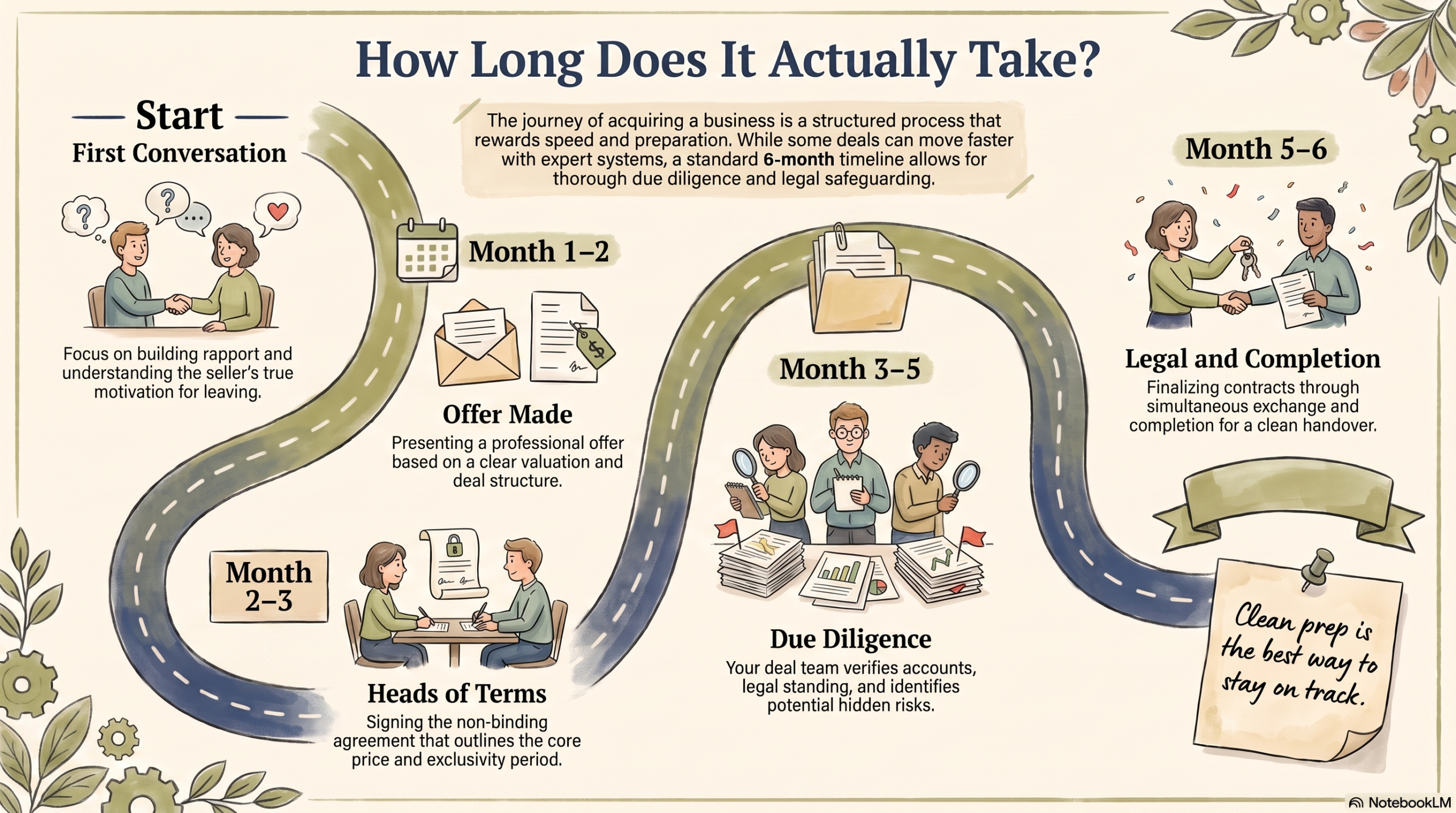
Most straightforward deals take between two and four months from the point of agreeing Heads of Terms to completion. Finding the right buyer — before that process even starts — can take considerably longer, which is why starting early matters.
Stage 1: Finding the Right Buyer
The first decision you make as a seller is how you’re going to find a buyer. There are broadly two routes.
Going through a broker
A business broker will market your business — usually through a listing on a marketplace, combined with direct outreach to their buyer network. This approach casts a wide net and can work well for certain types of business. The downsides are that your business becomes publicly listed, which means staff, customers, and competitors can find out you’re selling. Broker fees are also significant — typically between 5% and 10% of the sale price.
A private, off-market sale
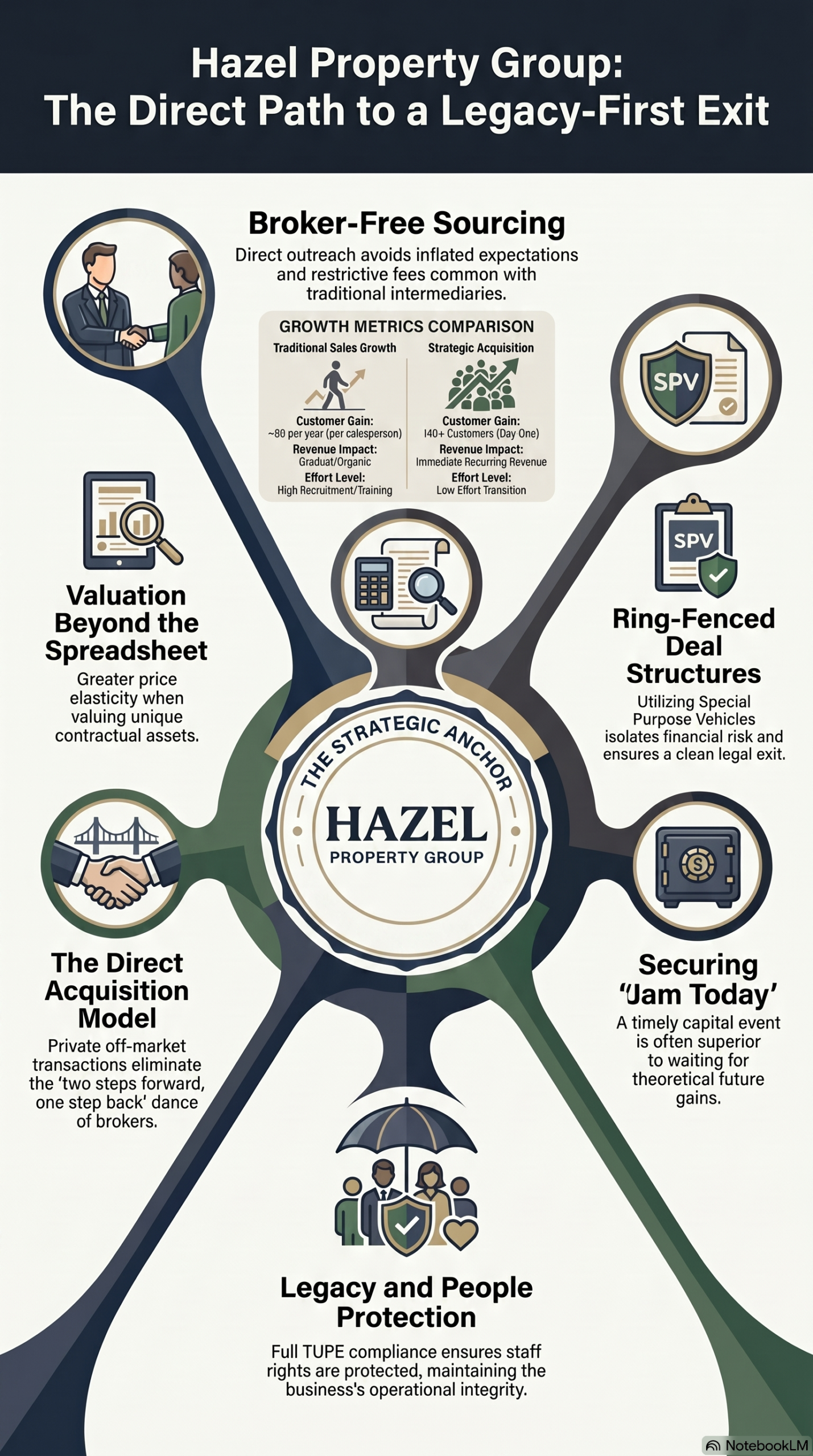
An increasing number of business owners prefer to sell privately and directly to a buyer, without going to market. This approach keeps the sale confidential, avoids broker fees, and means you’re dealing with a buyer who has specifically sought you out rather than responded to a listing.
At Hazel Property Group, this is how we operate. We approach businesses directly, off-market, and handle the process privately and on the seller’s terms.
The right approach depends on your circumstances. But if confidentiality matters to you — and for most owner-managers it does — it’s worth understanding what a private sale looks like before you instruct a broker.
Stage 2: Agreeing the Deal in Principle
Once you’ve found a buyer you want to work with, the first substantive conversation is about price and structure.
How is price calculated?
For most owner-managed businesses, value is calculated using a multiple of EBITDA — Earnings Before Interest, Tax, Depreciation and Amortisation. In plain English, that means the profit the business generates before certain deductions are taken out.
The multiple applied to that profit figure depends on a number of factors: the size of the business, how stable the revenue is, how reliant the business is on the owner, the strength of the customer base, and conditions in the wider market.
For businesses in the £500k to £10m revenue range, multiples typically sit between one and four times EBITDA, with the higher end reserved for businesses with strong recurring revenue, solid management teams, and low owner dependency.
How is payment structured?
Most private business sales are not all-cash on day one. A typical deal involves an initial payment on completion — which might be funded using cash already in the business, borrowing against business assets, or the buyer’s own capital — followed by deferred payments over one to three years, funded by the profits the business generates.
This structure works well for both sides. The seller gets a clean exit without the buyer needing to raise the full price upfront. The buyer acquires the business and pays for it progressively as it generates returns.
Some deals also include an earnout element — where part of the price is linked to the future performance of the business. If the business hits its targets, the seller receives more. If it falls short, they receive less. This can bridge the gap when buyer and seller have different views on what the business is worth.
Stage 3: Heads of Terms
Once a deal is agreed in principle, both sides sign a document called Heads of Terms — sometimes called a Letter of Intent or HOTs.
Think of this like the written confirmation you receive when a house offer is accepted. The price and broad terms are set out, but the detailed legal work hasn’t started yet.
Heads of Terms typically cover:
- The purchase price and payment structure
- What is included in the sale — shares or assets
- The proposed timeline
- An exclusivity period
- Key conditions on either side
Most of the document is not legally binding — it’s a statement of intent. However, the exclusivity clause is binding, and it’s important. It means the seller agrees not to talk to other buyers for a set period — typically three to five months — while the buyer spends money on due diligence and legal fees.
Before signing Heads of Terms, it’s worth having your lawyer review them. Any red lines — things you’re not willing to agree to — are much easier to raise at this stage than three months later when the legal process is underway.
Stage 4: Due Diligence
Due diligence is the stage that makes most sellers nervous. But it shouldn’t.
The best way to understand due diligence is to think of it as a survey — the same survey a buyer gets done before purchasing a house. The surveyor isn’t assuming the house is falling down. They’re just making sure that what’s being paid for is genuinely what’s being received.
Financial due diligence
The buyer’s accountant will review the last three years of accounts, VAT returns, management accounts, corporation tax returns, and the overall financial position of the business. They’re checking that the profit figures are accurate, the tax is paid and up to date, and there are no financial surprises.
Legal due diligence
The buyer’s lawyer will review employment contracts, client contracts, supplier agreements, property leases, and any ongoing or threatened disputes. They’re checking that the business’s legal house is in order and that nothing significant has been left undisclosed.
Commercial due diligence
This is the buyer’s own assessment of the business — the strength of the customer base, key relationships, the market the business operates in, and the risks and opportunities ahead.
All of this information goes into a data room — a secure online folder that both sides can access. The buyer’s lawyer sends an information request at the outset, and the seller’s job is to respond to that fully and promptly.
The sellers who have the smoothest experience of due diligence are the ones who are organised and transparent. The more complete your responses, the faster the process moves.
Due diligence can occasionally lead to a renegotiation — if something unexpected comes up, the buyer may ask to adjust the price or payment terms. That’s normal and doesn’t mean the deal is in trouble. A buyer who raises a concern during due diligence is a buyer who is still engaged and wants to find a way through.
Stage 5: The Sale Agreement
While due diligence is underway, the buyer’s lawyer starts drafting the sale agreement. This is the main legal document — it sets out everything that has been agreed and provides the legal framework for the transaction.
Share purchase or asset purchase?
Most private business sales are structured as share purchases — the buyer buys the shares in your limited company, taking ownership of everything the company owns and owes. This is usually simpler and faster than an asset purchase, and it has tax advantages for the seller.
An asset purchase — where the buyer buys specific assets, contracts, and goodwill rather than the company itself — is sometimes used for sole traders, partnerships, or where there are specific reasons not to take on the company’s history.
Warranties and indemnities
The sale agreement will contain a set of warranties — formal promises you make as the seller about the business. Things like: the accounts are accurate, the tax is paid, all staff are properly employed, and there are no undisclosed disputes.
If a warranty turns out to be untrue, the buyer can make a claim against you. In practice, warranty claims are difficult and expensive to pursue, which is why they tend to act more as a deterrent than anything else. But they are important, and your lawyer’s job is to make sure you’re not signing up to promises you can’t keep.
Indemnities are different — they cover specific issues that have been identified during due diligence. If a particular risk materialises, you pay the buyer pound for pound. Indemnities are cleaner and easier to enforce than warranties.
The disclosure letter
Alongside the sale agreement, you’ll prepare a disclosure letter with your lawyer. This is your opportunity to formally declare anything about the business that the buyer needs to know before completion. Think of it like the seller’s property information form on a house sale.
The disclosure letter protects you as the seller. If something is properly disclosed, the buyer cannot later claim breach of warranty on that point. Your lawyer will go through every warranty in the agreement with you to make sure everything is accurately disclosed.
Stage 6: Completion
Completion is the day the business changes hands.
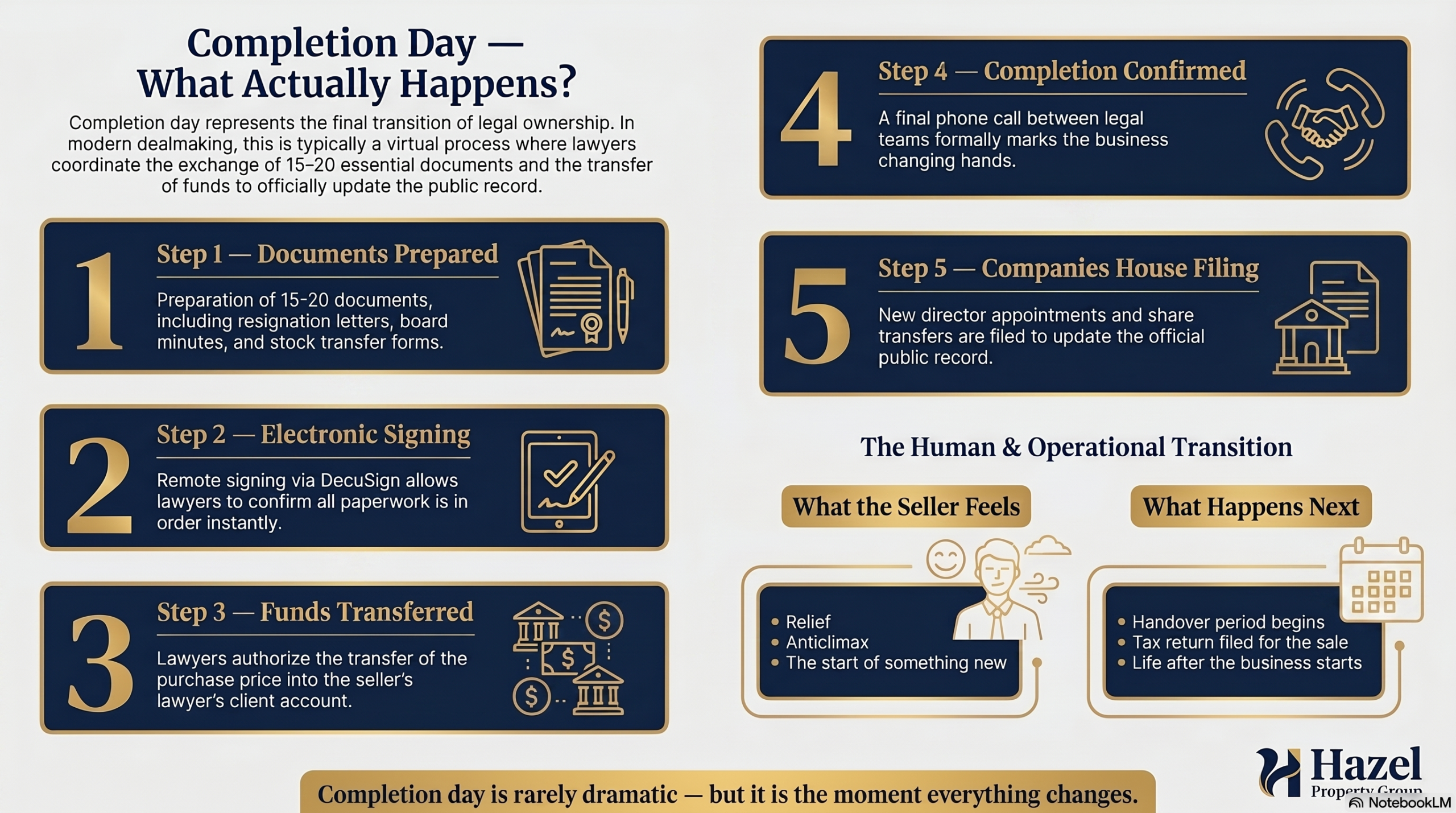
In almost all cases now, completion happens remotely. Documents — typically fifteen to twenty of them in a share sale — are signed electronically through platforms like DocuSign. Money is transferred. Companies House filings are made. And at that point, you are no longer the owner of the business.
Most deals are done on a simultaneous exchange and completion basis — meaning contracts are exchanged and the deal completes on the same day. The alternative — exchanging contracts and completing a few weeks later — is occasionally used but much less common.
Completion day is usually anticlimactic. There’s no big handshake moment — just a series of notifications that documents have been signed and funds have cleared. But it’s a significant moment nonetheless.
What Happens After Completion?
Most sellers agree to a handover period — a defined period of time, typically one to six months, during which they remain available to help the buyer get to grips with the business. This might be a few days a week rather than full time.
The handover covers everything from introducing key clients and staff to the practical details of how the business operates day to day — systems, supplier relationships, recurring processes, and everything in between.
In some deals, the seller agrees to stay on in a consultancy capacity for longer, particularly where they have deep relationships that need to be carefully transitioned.
How Long Does the Whole Process Take?
From Heads of Terms to completion, most straightforward deals take two to four months.
The most common causes of delay are:
- Property — if there’s a commercial lease, the landlord usually needs to consent to the change of ownership, which can take time
- Slow responses during due diligence — the faster the seller provides information, the faster the process moves
- Protracted legal negotiation — usually a sign that one or both sets of lawyers are not experienced in SME transactions
- Unexpected issues arising in due diligence that need to be worked through
Finding the right buyer — before the formal process even starts — can take considerably longer, particularly if you’re approaching the market through a broker. This is one reason why thinking about your exit well in advance of when you actually want to sell is so valuable.
What Does It Cost to Sell a Business?
Selling a business involves professional fees on both sides. As the seller, the main costs you’ll incur are:
- Lawyer’s fees — for a straightforward SME sale, typically £8,000 to £15,000 depending on complexity
- Accountant’s fees — for financial due diligence support and tax advice on the sale proceeds
- Tax — the sale of business shares typically qualifies for Business Asset Disposal Relief, which reduces Capital Gains Tax to 10% on qualifying gains
If you sell through a broker, their fee — usually 5% to 10% of the sale price — is the largest single cost. A private sale avoids this entirely.
Key Things to Have in Order Before You Start
The sellers who achieve the best outcomes are the ones who are prepared. Before you enter into any sale process, it’s worth making sure the following are in good shape:
- Three years of filed, accurate accounts
- Up to date corporation tax and VAT returns
- Signed employment contracts for all staff
- Copies of key client and supplier contracts
- Details of any property leases
- Awareness of any outstanding disputes or potential claims
- A clear understanding of your business’s profit — and what adjustments might be made to normalise it for a buyer
None of this needs to be perfect. Most businesses that sell successfully have rough edges — that’s normal. What matters is that you know what they are and can talk about them openly.
Final Thoughts
Selling a business is one of the most significant financial transactions most owner-managers will ever make. It deserves the same care and preparation as any other major decision.
The good news is that the process — while it has its own language and conventions — is entirely manageable once you understand what’s happening at each stage and why.
If you’re thinking about selling your business — whether that’s this year or in a few years’ time — the best thing you can do is start the conversation early, while you have time and options on your side.
At Hazel Property Group, we buy owner-managed UK businesses privately and directly — no brokers, no public listings, and no pressure. If you’d like a confidential conversation about your own situation, get in touch at hazelpropertygroup.co.uk.
Further Reading
If you found this guide useful, you might also want to watch our YouTube Process Series, which covers each stage of selling a business in more detail:
- What Happens Between Agreeing a Deal and Completing It
- What Are Heads of Terms?
- What Does Due Diligence Involve?
- What Does a Lawyer Do When You Sell Your Business?
Search Hazel Property Group on YouTube or visit hazelpropertygroup.co.uk to find the full series.